





.webp)





Who Does What on a Large Construction Site
Read more



Every construction project has risks. Bad weather, late material deliveries, currency fluctuations, and labour strikes. The difference between a project that succeeds and one that fails is not the absence of risk, but how the contractor handles it.
The leading contractors in Pakistan do not ignore risks or hope they go away. They have formal risk management systems that start before the first shovel hits the ground and continue until the final handover. These systems save millions of rupees and prevent costly delays.
This blog explains the core risk management strategies used by top contractors: risk identification, contingency planning, insurance, and real‑time monitoring. You will learn how these strategies are applied in Pakistan's unique environment. For a broader view of what makes a contractor reliable, visit AMCORP's homepage.
The leading contractors in Pakistan follow a structured approach to risk. Here are the four pillars.
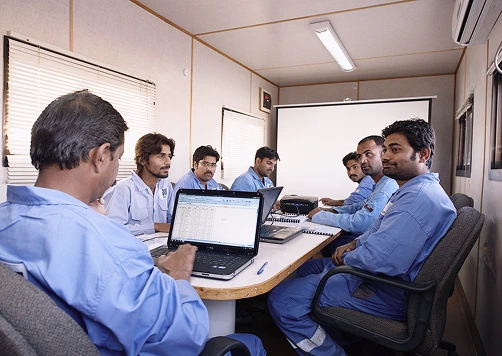
1. Risk identification and assessment. Before a project starts, the contractor holds a risk workshop with all department heads. They list every possible risk: technical, financial, operational, and external. Each risk is rated on probability (low, medium, high) and impact (low, medium, high). The result is a risk register, a living document that is reviewed weekly. The Project Management Institute (PMI) provides standard templates for this process.
2. Contingency planning. For high‑probability, high‑impact risks, the contractor develops specific mitigation plans. For example, if a cement shortage is rated high risk, the mitigation might be pre‑ordering bulk cement with a fixed price contract. Contingency plans also include time buffers. Leading contractors add 10 to 15 percent schedule contingency for known risks and 5 percent for unknown risks.
3. Transfer of risk through insurance and bonds. Some risks cannot be eliminated, only transferred. The leading contractors in Pakistan carry comprehensive insurance: third-party liability, workers' compensation, professional indemnity, and contractors' all risk. They also require subcontractors to provide their own insurance. Performance bonds transfer the risk of default to a bank. The Pakistan Engineering Council (PEC) mandates certain insurance levels for different contract grades.
4. Real‑time monitoring and response. A risk register that sits on a shelf is useless. Leading contractors review risks at every weekly progress meeting. When a risk becomes an actual problem, they execute the pre‑planned mitigation immediately. This speed is what separates market leaders from the rest.
These four strategies are not theoretical. They have been tested on projects like the QICT port expansion and the Naimat gas plant, both of which were delivered with minimal cost overruns.
Let us take a concrete example. A leading contractor is building a 10 MW solar power plant in Punjab. The risk register might include the following.
Risk: Delayed import of solar panels (probability high, impact high). Mitigation: The contractor orders panels six months before they are needed. They also maintain a list of alternative suppliers in China and Europe. A dedicated logistics officer tracks the shipment daily. If the ship is delayed at port, the officer expedites customs clearance through a pre‑arranged agent.
Risk: Grid connection delay from the power utility (probability medium, impact high). Mitigation: The contractor submits interconnection applications on day one of the project, not week ten. A liaison officer meets with utility engineers monthly. If approval is still delayed, the contractor has a backup plan: a temporary diesel generator to test the plant before grid connection.
Risk: Monsoon flooding of the site (probability medium, impact medium). Mitigation: The contractor builds temporary drainage channels and stocks sandbags before the rainy season. The construction schedule is adjusted so that critical electrical equipment is installed after the monsoon, not during.
Risk: Rupee devaluation increasing material costs (probability medium, impact medium). Mitigation: The contractor negotiates a price escalation clause in the contract. They also purchase major items like inverters and cables in dollars upfront, hedging against currency drops.
Each risk is reviewed weekly. When the rupee actually devalues by 5 percent, the contractor triggers the price escalation clause and submits a variation request within days. There is no panic because the plan already exists.
This systematic approach is why leading contractors in Pakistan finish projects with fewer surprises. Our quality management system integrates risk management into every phase.

Global risk management frameworks are useful, but Pakistan adds unique challenges. The leading contractors in Pakistan have developed specific responses.
Security risks in certain regions. For projects in Balochistan, KP, or interior Sindh, contractors face risks of theft, extortion, or even violence. Leading contractors hire licensed private security companies, coordinate with local police, and conduct security audits. They also build secure storage areas for equipment and materials. The risk register includes evacuation plans and emergency communication protocols. Our ethics and compliance approach includes community engagement to reduce security tensions.
Utility outages. Power cuts and water shortages are not emergencies in Pakistan; they are daily realities. Leading contractors build on‑site backups: diesel generators, water tanks, and sometimes solar‑powered site offices. They also schedule energy‑intensive activities like welding during off‑peak hours when the grid supply is more stable.
Payment delays from clients. This risk is so common that leading contractors treat it as almost certain. Mitigation includes progress billing every two weeks instead of monthly, maintaining cash reserves equal to three months of operating costs, and having legal counsel review all payment clauses. Contractors also keep open communication with clients, offering revised schedules rather than stopping work abruptly.
Labour shortages during harvest season. In rural areas, labourers return to their villages for the wheat or rice harvest. Leading contractors anticipate this by adjusting schedules. They also maintain a core team of permanent workers who are paid year‑round regardless of harvest seasons. Our career development programs help retain skilled workers, reducing reliance on daily wage labour.
Supply chain breakdowns. A single supplier failing to deliver cement or steel can halt a project. Leading contractors qualify at least two suppliers for every critical material. They also keep safety stock on site. For example, a contractor building a high‑rise might store enough steel for two floors ahead of time.
These Pakistan‑specific adaptations are not taught in MBA programs. They are earned through years of experience. Contractors who master them become market leaders.

The leading contractors in Pakistan view risk management not as a cost, but as a competitive advantage. By identifying, planning, and mitigating risks early, they avoid the delays and cost overruns that plague their competitors. Clients notice. That is why leading contractors get repeat business.
For project owners, this means you should evaluate a contractor's risk management maturity before signing a contract. Ask to see their risk register from a recent project. Ask about their insurance coverage and bond capacity. Ask how they handle utility outages or payment delays. The answers will tell you whether you are hiring a leader or a beginner.
If you are a construction professional, these strategies are career accelerators. Learn to facilitate risk workshops. Learn to build contingency plans. Learn to monitor risks weekly. These skills are rare and highly valued.
Risk is unavoidable. But with the right systems, it becomes manageable. The leaders have already figured this out. Now you can too. To see how we apply these strategies on our own projects, explore our portfolio of EPC projects and our safety approach.


Where Pakistan's cement, bricks, steel, and aggregate are produced, how far they travel to site, and why sourcing distance shapes cost, schedule, and emissions.