



.webp)



Where Pakistan's Construction Materials Come From, and Why It Matters
Read more



Karachi is a city in a hurry. New warehouses, housing schemes, and commercial plazas are needed yesterday. But traditional construction is slow. Weather delays, material shortages, and labour issues stretch timelines for months. Meanwhile, construction waste piles up at every site, adding to the city's environmental problems.
A growing number of construction firms in Karachi have found a better way: modular construction. Also known as prefabrication or off‑site manufacturing, this method involves building components like walls, staircases, and even entire rooms in a factory. Then these pieces are transported to the site and assembled like building blocks. The result is faster completion, less waste, and higher quality.
This blog explains how modular construction works, why it is gaining traction in Karachi, and which local projects already use these techniques. For a broader view of sustainable building practices, visit AMCORP's homepage.
Modular construction is not a futuristic concept. It is a practical method already used worldwide. The core idea is simple: move the construction process from an uncontrolled outdoor site to a controlled factory environment.
Here is how it works in practice for construction firms in Karachi. A building is divided into modules or panels. For example, wall panels with windows, insulation, and electrical conduits pre‑installed. Or bathroom pods with tiles, fixtures, and plumbing already in place. These modules are manufactured in a factory using precision machinery. Quality checks happen at every step. Once ready, the modules are loaded onto trucks, delivered to the site, and lifted into position by cranes.
The benefits are substantial. First, speed. Factory production and site preparation happen simultaneously. A building that would take 12 months using conventional methods can be completed in 6 to 8 months with modular construction. Second, quality control. Factory conditions mean consistent welding, accurate cutting, and proper curing. Third, reduced waste. Factories recycle offcuts and excess materials. On a conventional site, waste often ends up in landfills. Fourth, less disruption to the neighbourhood. Noisy activities are confined to the factory, not the crowded streets of Karachi.
A real example of modular thinking in Karachi is the Parco Precast Wall project. Precast concrete walls are a form of modular construction. They were manufactured off‑site, then transported and installed quickly. This approach saved weeks compared to casting walls on location.
The Modular Building Institute (MBI) provides global standards for this method. In Pakistan, the Pakistan Engineering Council (PEC) has recognised precast and prefabricated systems as valid construction technologies. As more construction firms in Karachi adopt modular techniques, the industry is becoming faster and cleaner.
Let us walk through a typical modular project in Karachi. Imagine a developer needs a five‑storey residential building in a dense area like Gulshan‑e‑Iqbal. Site access is tight, and neighbours will complain about noise. Here is how a contractor using modular methods would proceed.
Phase 1: Design and engineering. The building is designed as a series of repeatable modules. Wall panels, floor slabs, and staircases are dimensioned to fit on standard trucks. Connections between modules are engineered for strength and water tightness.
Phase 2: Factory fabrication. While site clearing and foundation work happen, the factory produces the modules. Concrete is poured into precision moulds. Steel reinforcement is placed according to drawings. Electrical conduits and plumbing chases are embedded. Each module is numbered and quality checked.
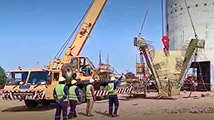
Phase 3: Delivery and assembly. Trucks deliver modules to the site just in time. A mobile crane lifts each panel into place. Workers bolt them together, seal joints, and complete connections. Within a few weeks, the building frame is fully erected. Conventional construction would still be on the first floor slab.
Phase 4: Finishing. Because modules already include windows, insulation, and services, the finishing phase is short. Internal partitions, flooring, and fittings are completed quickly. The building is ready for occupancy months ahead of schedule.
This approach is not just for residential buildings. Industrial warehouses, office complexes, and even schools can be built modularly. The finishing and fit‑out works that AMCORP undertakes often include prefabricated elements that speed up interior completion.
The Pakistan Green Building Council encourages modular construction because it significantly reduces construction waste and energy use. For construction firms in Karachi, this is a competitive advantage. Clients increasingly demand faster delivery and lower environmental impact.
Adopting modular construction in Karachi is not without hurdles. The construction firms in Karachi that succeed have learned to navigate local realities.
Factory availability. Few dedicated modular factories exist in Karachi. Leading contractors either set up their own temporary fabrication yards or partner with precast concrete suppliers. For example, the Parco precast wall project used a local precast facility to produce the walls. This is a practical workaround until the industry matures.
Transportation logistics. Karachi's roads are congested, and bridges have weight limits. Modules must fit within standard truck dimensions. Smart contractors design modules that are no wider than 10 feet and no heavier than 15 tons. They also schedule deliveries at night to avoid traffic.
Crane access. Modular assembly requires mobile cranes. In narrow streets, positioning a crane can be difficult. Contractors survey the site in advance and sometimes use smaller cranes or even boom lifts. They also coordinate with local police for temporary road closures.
Building code acceptance. Some building control authorities are unfamiliar with modular methods. Leading contractors submit detailed engineering calculations and references to international codes. Once the first modular project is approved, subsequent ones become easier. Our quality assurance system includes documentation that helps authorities understand modular safety.
Labour training. Workers accustomed to brick and mortar need retraining for modular assembly. Leading firms invest in on‑the‑job training, showing workers how to align panels, tighten connections, and seal joints. Over time, a skilled modular crew becomes highly productive.
Perception issues. Some clients think modular means cheap or temporary. The best contractors show examples of high‑end modular buildings, such as the ABL Lahore Office which used precast elements, or international case studies. Once clients see the quality, they become advocates.
Despite these challenges, the momentum is clear. Construction firms in Karachi that embrace modular construction are winning projects because they offer shorter timelines, predictable costs, and less waste. Those that ignore the trend will struggle to compete.
The International Code Council (ICC) has published guidelines for modular construction that Karachi's authorities are beginning to reference. Contractors who align with these standards are future‑proofing their businesses.
Modular construction is not a passing fad. It is a practical response to Karachi's urgent need for fast, clean, and affordable building. The construction firms in Karachi that adopt modular techniques are already seeing results: projects delivered in half the time, waste reduced by up to 80 percent, and quality that surpasses conventional methods.
For clients, the advantages are clear. If you need a warehouse, a housing block, or an office building, ask your contractor whether they offer modular or prefabricated options. Compare the timeline and total cost. You will likely find that modular saves you months and reduces the headaches of on‑site construction.
For contractors, the message is equally clear. Invest in modular capabilities now. Build relationships with precast suppliers. Train your crews. The early adopters will dominate the market.
To see how modular thinking can be integrated into large‑scale projects, explore our portfolio of structural building works and our EPC projects. The shift to modular is happening. Do not get left behind.

What a construction company profile should contain, how clients read it during prequalification, and the common gaps that cost contractors work before evaluation begins.